Bushfire Prone Land Map New South Wales
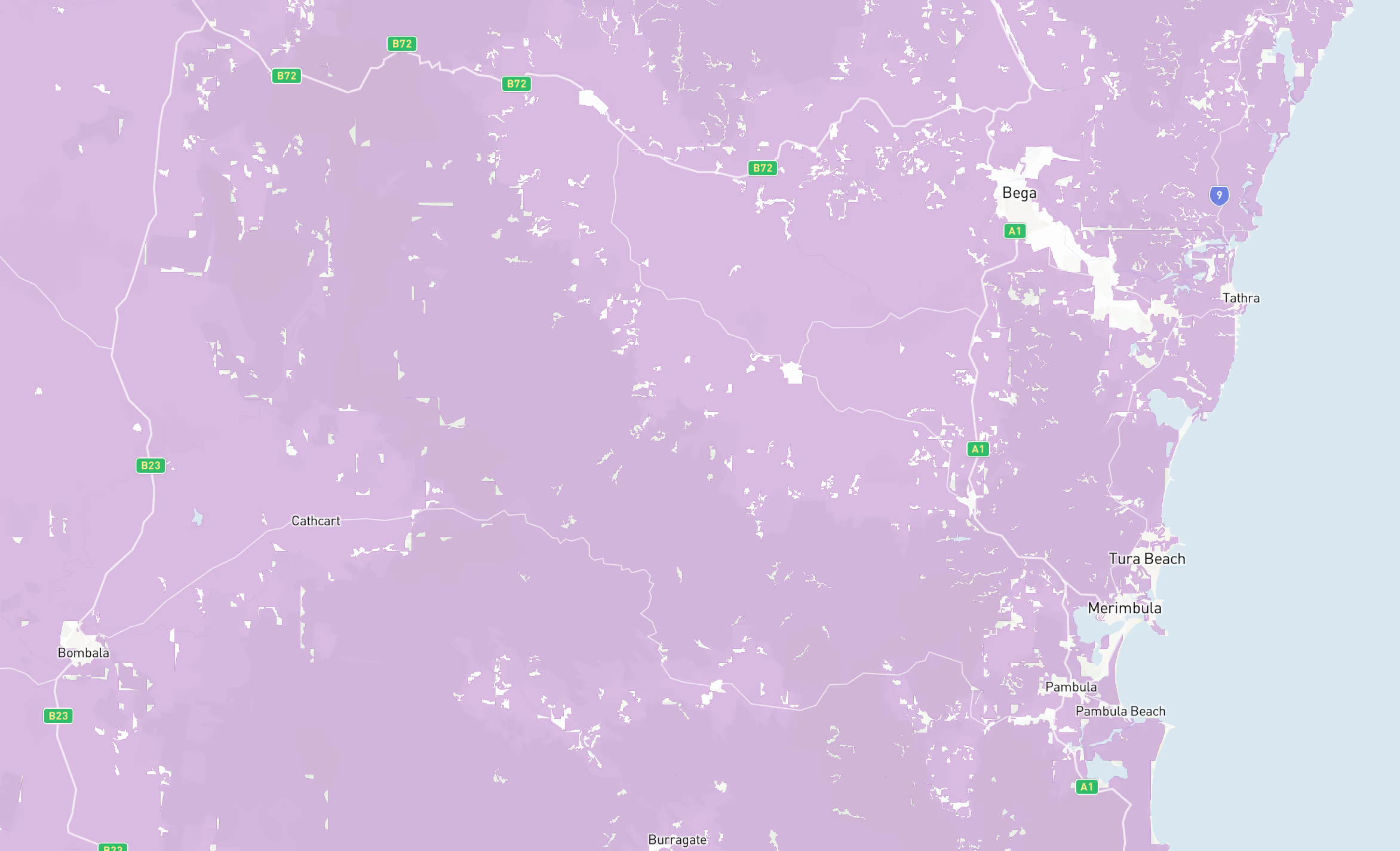
By Landchecker
Last reviewed: 17 November 2026
Bushfire prone land in New South Wales (NSW) is land the local council has identified as able to support a bushfire or susceptible to bushfire attack, as recorded on a map certified by the Commissioner of the NSW Rural Fire Service (RFS).
A 2026 study led by the University of Wollongong looked at properties destroyed in NSW during the 2019–20 Black Summer fires and found 81% were on land mapped as bushfire prone.
Warm and dry conditions, when grasses are dead, fuels have dried, and intense high-pressure systems are in place, increase fire risk across many states. It affects NSW communities, farmers, local businesses, wildlife and bushland.
If a property or area is bushfire prone, bushfire protection has to be built into any new development there. Your development application (DA) is assessed against Planning for Bush Fire Protection, the RFS guidelines for building in bushfire areas. You’ll also need to conduct a bushfire attack level (BAL) assessment and ensure new developments are built to Australian Standard AS 3959.
This article explains how the NSW map works, what vegetation categories 1, 2 and 3 mean, what a designation triggers, and how to check a property on the Landchecker map and through official NSW sources so you can be well-informed and prepared before a bushfire.
What is a Bushfire Prone Property/Land?
Bushfire prone land (BFPL) is land that has been identified by the local council and certified by the NSW RFS Commissioner as being subject to bushfire attack or capable of supporting a bushfire.
Generally, land is categorised as bushfire prone based on the vegetation and whether it is set near significant “dry fuel” (this can include leaf litter, bark, small branches and twigs, shrubbery, and so on).
With recent and ongoing bushfires across NSW, bushfire prone land maps in NSW are more necessary than ever.
What are the vegetation categories on a bushfire prone land map?
A bushfire prone land map shows vegetation categories that classify plant life by combustibility and the likelihood of fully developed fires. Here are the vegetation types on a bushfire prone land map:
What happens if my property is on bushfire prone land?
If you have proposed development on land that is designated as bushfire prone, you have a legal obligation to consider bushfire and meet the relevant specifications and requirements of Planning for Bush Fire Protection 2019 (PBP), which covers five areas including asset protection zones, access, water supply, landscaping, and building design and construction.
Development applications (DA)
The approval process for development applications changed on 1 July 2026:
- Your council must consider PBP before it approves a DA on bushfire prone land.
- If your proposal doesn't comply with PBP and you don't have a certificate from a bushfire consultant recognised by the RFS, the council must notify the Development Coordination Authority (DCA) and take its comments into account.
- The DCA is now the single point of contact for state agency referrals, including bushfire matters that used to go to the RFS.
- DAs lodged before 1 July 2026 are assessed under the previous rules.
Check with your council whether your DA needs a bushfire assessment report. Not every application does, and for a single dwelling you can use the RFS applicant kit rather than hire a consultant.
Bushfire attack level (BAL) and AS 3959
BAL ratings measure how vulnerable a structure is going to be to attacks by embers, radiant heat and direct flames. They are calculated based on fire weather characteristics, vegetation types, distance from the building and slope of the land for your particular site.
The six different levels are BAL-LOW, BAL-12.5, BAL-19, BAL-29, BAL-40 and BAL-FZ (Flame Zone) in order of increasing danger. The BAL determines what construction standards apply to your building according to the Australian Standard AS 3959:2018 or the NASH Standard for steel-framed structures.
How to check a property in Landchecker
You can utilise the Bushfire Prone Land Map for NSW, or other states via Landchecker. This tool will enable you to assess potential risk to the LGA of your existing or future property investment.
Since maps are updated periodically you will always receive the most up to date and accurate data at the time of your search.
Here’s how to use a Map to Check if a Property is in a Bushfire Prone Zone. It only takes a few clicks:
- Using the Landchecker Map feature enter a relevant address
- Click on “Due Diligence”
- Apply the map layer “Bushfire Prone Area”. Zoom in/out as needed and use the right hand side to see the bushfire status of an area
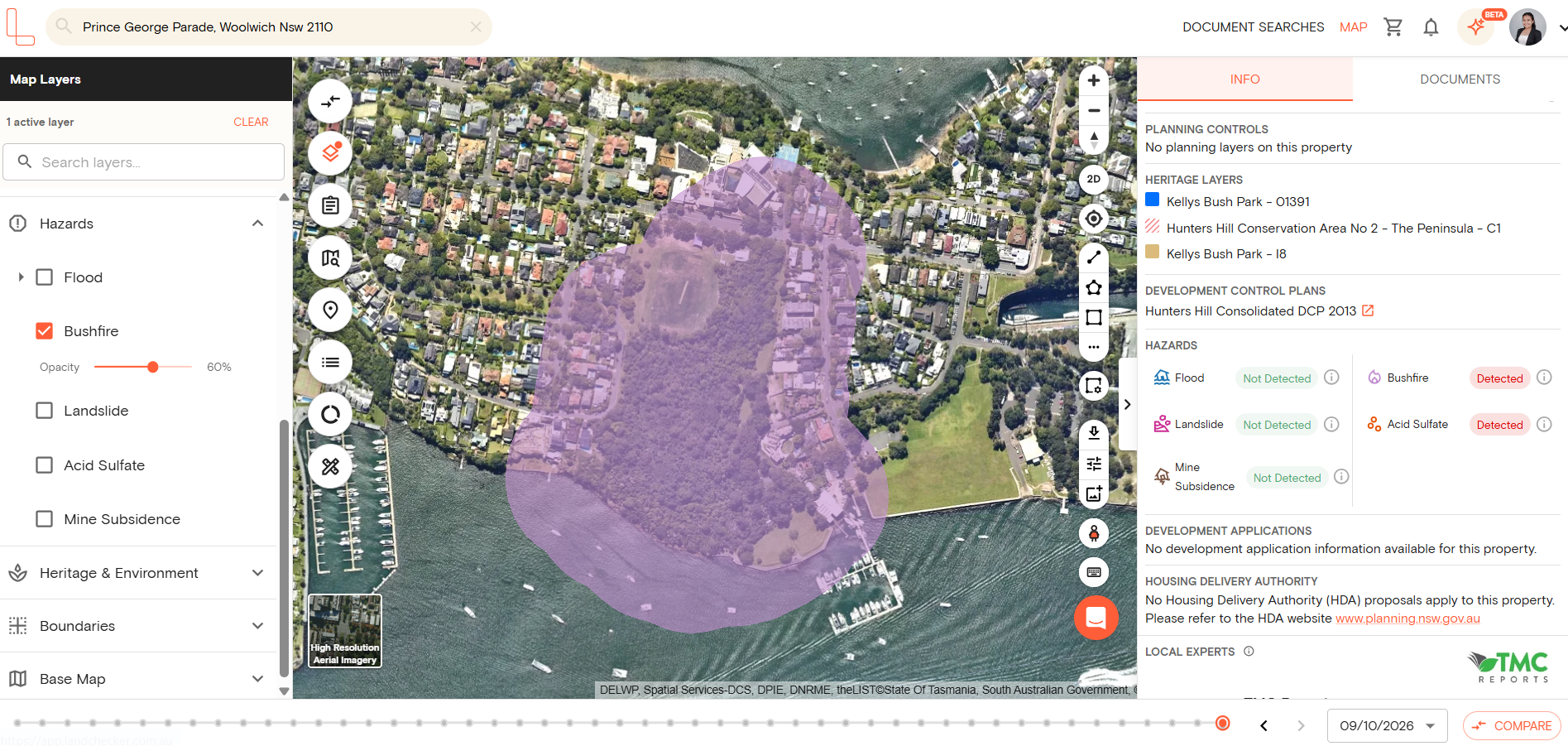
All information is available for immediate download via a free property report. Not only will the report indicate if the area is bushfire prone, but it will also show other details like flooding, heritage status, zoning and much more. You can upgrade your report to receive an even more robust picture and additional data.
By understanding the geography and historical data of bushfires in your area, you’ll be able to make the most informed decisions about the land (and/or property) in question.
How often are bushfire prone land maps updated?
Bushfire prone land maps are updated every five years to reflect changes in vegetation. Under section 10.3 of the Environmental Planning & Assessment Act 1979 (EP&A Act), it is each council’s responsibility to contact the RFS before the five-year certification period has ended and request that the council's bushfire prone land map be reviewed and re-certified.
Landchecker carries the NSW bushfire hazard dataset from the NSW RFS, refreshed weekly. To see when a property's data was last updated, click Bushfire in the Hazards section under the right-hand side Property Information panel.
Precautions to Take to Protect Your Property
It’s understandable to think that if the area has not been affected by a bush fire that it is safe from danger. However, conditions can change, especially with impending climate change increasing the risk of bushfire over time.
Some of the key precautions you can take to protect your property from bushfire include those at the build and maintenance level, such as:
- Install metal gutter guards
- Pay attention to weather conditions
- Reduce any gaps/external openings to 2mm or less and fit seals around doors and windows
- In the build stage, simplify the house outline and roof line to reduce debris build up and switch combustible materials like wood for fire resistant ones like lightweight steel
- Maintain your land and home by regularly pruning trees, maintaining grass and clearing dry fuel like leaves
The main step is assessing the risk of bushfires in your area.
You can do this by checking the bushfire zone maps in NSW using Landchecker.
Councils are legally required to map bushfire prone land within their LGA’s and the NSW Bush Fire Prone Land (BFPL) dataset is a map prepared from council data that is certified by the Commissioner of the NSW Rural Fire Service.
Any area that can support a bushfire or is likely to be subject to a bushfire attack will be designated on a BFPL map.
There are three different vegetation categories that will be depicted from high to lower risk and map data is updated regularly to account for variations in vegetation and so on.
Frequently asked questions
What is bushfire prone land in NSW?
The NSW Rural Fire Service defines bushfire prone land as land identified by the local council and certified by the NSW RFS Commissioner as capable of supporting a bushfire or likely to be subject to bushfire attack.
What are the vegetation categories on a bushfire prone land map?
The vegetation categories include categories 1, 2 and 3, reflecting different vegetation types and associated buffer distances, so the numbers aren't a ranking. Category 3 was added in 2015 to cover grasslands.
- Category 1: forests, woodlands, heaths, forested wetlands and timber plantations, with a 100-metre buffer.
- Category 2: rainforests and lower-risk vegetation, such as remnant patches or land managed in a way that reduces bushfire risk, with a 30-metre buffer.
- Category 3: grasslands, freshwater wetlands, semi-arid woodlands, alpine complex and arid shrublands, with a 30-metre buffer.
What happens if my property is on bushfire prone land?
If you’re planning a new development on bushfire prone land, bushfire protection has to be built into it. Your council needs to assess your development application (DA) against Planning for Bush Fire Protection (PBP), and you’ll need a bushfire attack level (BAL) assessment to work out which AS 3959 construction standards apply to your building.
For DAs lodged on or after 1 July 2026, if your proposal doesn’t comply with PBP and you don’t have a certificate from an RFS-recognised bushfire consultant, your council must notify the Development Coordination Authority (DCA).
How do I check if a property is bushfire prone in NSW?
Use Landchecker to check if your NSW property is bushfire prone.
- Create or log in to your Landchecker account. Using the Landchecker Map feature, enter a relevant address.
- Click on “Map Layers” on the left-hand side menu.
- Select Bushfire under the Hazards section. Zoom in/out as needed and use the right-hand side property information panel to see the source authority and when the data was last updated.
You can also use the NSW RFS bushfire prone land online mapping tool or the NSW Planning Portal Spatial Viewer for the definitive answer. Your council's Section 10.7 planning certificate also states whether the land is bushfire prone.
How often are bushfire prone land maps updated?
Bushfire prone land maps are updated every five years to reflect changes in vegetation. Under section 10.3 of the Environmental Planning & Assessment Act 1979 (EP&A Act), it is each council’s responsibility to contact the RFS before the five-year certification period has ended.
Landchecker sources the NSW bushfire prone land dataset from the NSW RFS, refreshed weekly. To see when a property's data was last updated, click Bushfire in the Hazards section under the right-hand side Property Information panel.