
Product Help
How to view Car Parking Requirement maps in Victoria
Car Parking Requirement maps are a planning layer available in Landchecker that shows the minimum car parking requirements for land uses at specific locations across Victoria. The layer uses a colour-coded map display to indicate which parking category applies to a property or area.
This feature is available to all Landchecker subscribers and is useful for property developers, town planners, architects, and anyone assessing development feasibility in Victoria.
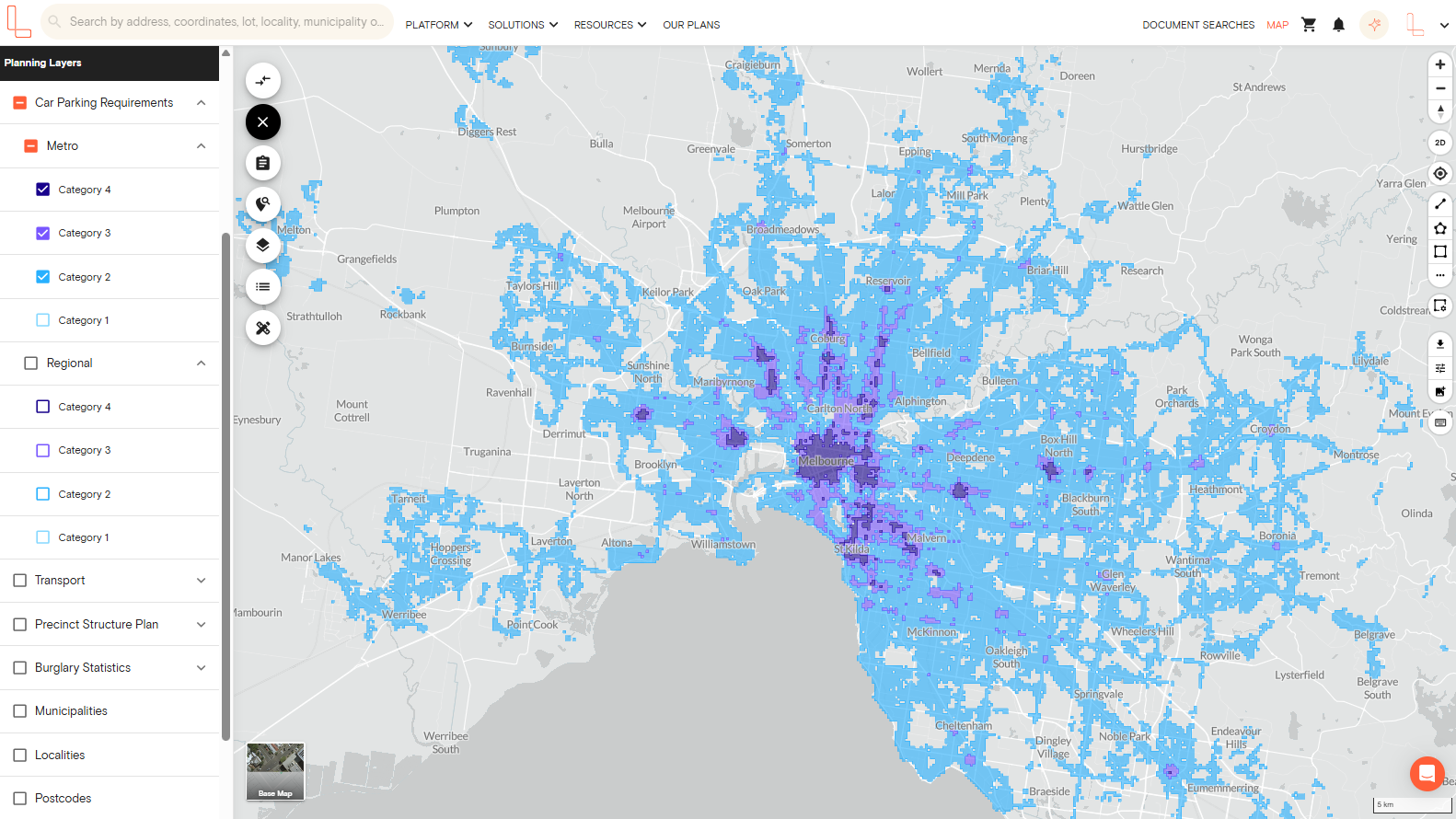
How do I turn on the Car Parking Requirements layer in Landchecker?
To view Car Parking Requirement maps in Landchecker, follow these steps:
Log in to your Landchecker account at app.landchecker.com.au.
Search for a property using the address search bar, or zoom into the area you want to assess on the map.
In the left-hand panel, click Planning Layers.
Tick the checkbox next to Car Parking Requirements to enable the full layer.
To narrow the display, you can tick either Metro or Regional sub-layer independently.
Within each sub-layer, you can also filter by individual category — Category 1, 2, 3, or 4 — to show only the zones relevant to your assessment.
Once enabled, the layer displays colour-coded zones on the map so you can identify which category applies to a property at a glance. Here’s a quick video on how to use the car parking requirement layer with other Landchecker features.
What do the Car Parking Requirement categories mean?
The Car Parking Requirement maps divide Victoria into four categories based on Public Transport Accessibility Level (PTAL) scores. PTAL measures how well-connected a location is to public transport.
Category 1: Lowest PTAL score
Areas with limited access to public transport. These locations have the highest car parking requirements because residents and users are more dependent on private vehicles.
Category 2: Low-to-moderate PTAL score
Areas with some public transport access. Standard car parking requirements apply.
Category 3: Moderate-to-high PTAL score
Areas with good public transport access. Reduced car parking requirements apply.
Category 4: Highest PTAL score
Areas with excellent public transport access. These locations have the lowest car parking requirements.
A location receives a higher PTAL score when one or more of the following conditions apply: it is within short walking distance of a train station or bus stop; services run frequently with short wait times; multiple routes or services are available at nearby stops; or major rail stations are located nearby.
The general principle is: better public transport access = lower car parking requirement.
What is the difference between Metro and Regional categories?
The Car Parking Requirement layer is divided into two geographic sub-layers: Metro and Regional. Each sub-layer contains its own Category 1–4 breakdown reflecting the public transport accessibility levels relevant to that area. You can view one or both sub-layers at the same time.
Does the Car Parking Requirements layer apply outside Victoria?
No. The Car Parking Requirement maps are currently available for Victoria only.
Why would I use the Car Parking Requirements layer?
The Car Parking Requirements layer helps you quickly understand the parking obligations that may apply to a proposed development before lodging a planning permit application. Knowing the category early in the feasibility process can influence site selection, design decisions, and development cost estimates.